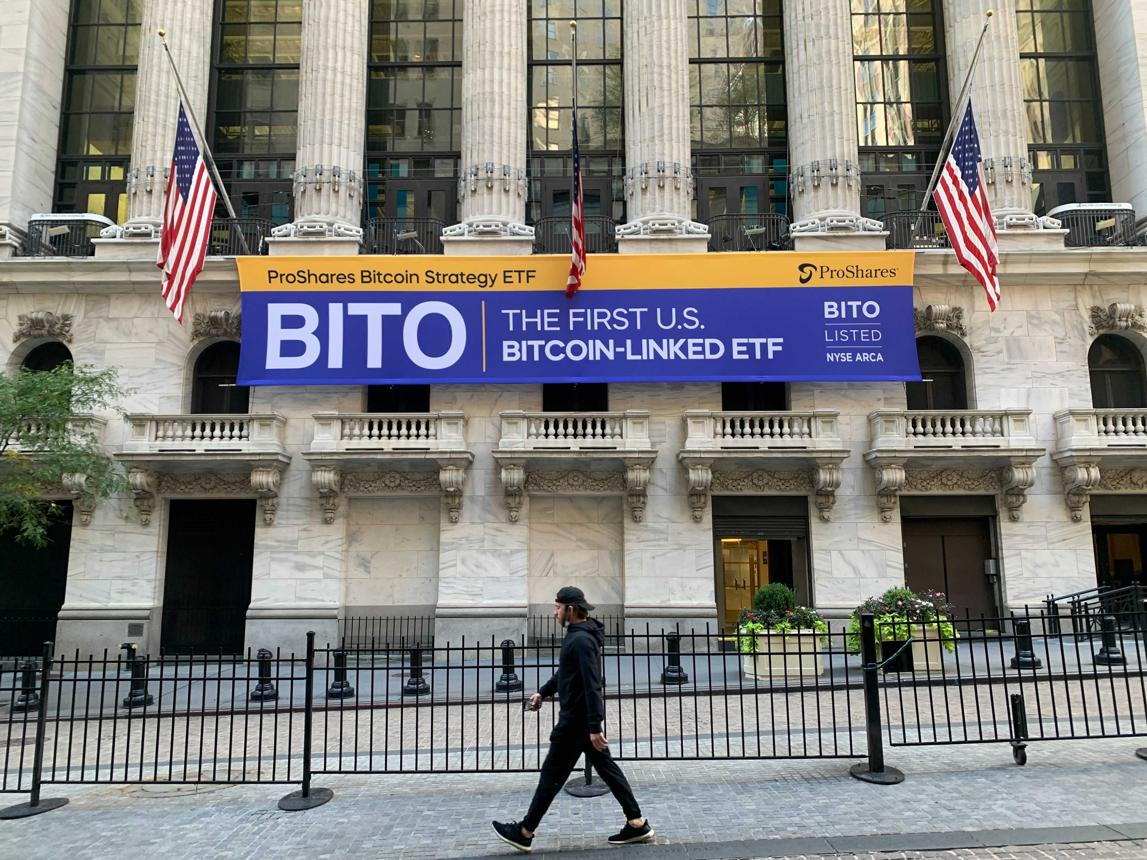
Bitcoin’s return to the $80,000 area is putting investors at a familiar crossroads: buy the dip, wait for confirmation, or stay away? Recent volatility, mixed spot ETF flows, elevated interest rates and inflation concerns make the decision less straightforward. For U.S. investors, the bigger question is not where Bitcoin goes next, but whether its risk fits their financial plan.
Bitcoin Around $80K: Why This Level Matters
Bitcoin has spent much of October testing the $80,000 area, turning a round number into an important psychological reference point for investors. The cryptocurrency briefly traded below $80,000 in mid-October before recovering, and it was back above $81,000 later in the week. The moves have been accompanied by significant swings in U.S. spot Bitcoin ETF flows.
That matters because Bitcoin’s market has changed considerably from its earlier years. Americans can now gain exposure through regulated brokerage products, including spot Bitcoin exchange-traded products, rather than needing to buy and custody the cryptocurrency themselves. At the same time, the underlying asset remains highly volatile and speculative.
The latest market action illustrates why a price such as $80,000 should not automatically be interpreted as either a bargain or a danger signal. A round-number price can attract buyers and sellers, but it does not establish the intrinsic value of an asset. Bitcoin does not generate corporate earnings, pay a traditional dividend or have a conventional valuation metric comparable to a stock.
Instead, its price is influenced by supply and demand, investor expectations, liquidity, macroeconomic conditions, institutional flows, regulation and sentiment.
That makes the question “Is Bitcoin at $80K a good buy?” more complicated than simply comparing today’s price with yesterday’s.
Why Bitcoin Has Been So Volatile
Several forces are currently competing for investors’ attention.
One is the broader interest-rate environment. Bitcoin is often treated as a risk asset, meaning investors can become less willing to own it when safer assets offer attractive yields or when economic uncertainty rises.
That relationship does not operate perfectly every day, but the current environment matters. The 10-year Treasury yield recently moved above 5%, while stronger inflation data increased concern about the path of U.S. monetary policy. Bitcoin subsequently came under pressure alongside other risk-sensitive assets.
The second major factor is ETF demand.
U.S. spot Bitcoin ETFs have created an easier route for investors who want exposure through traditional brokerage accounts. But ETF availability does not guarantee continuous buying pressure. Daily flows can reverse sharply depending on market conditions.
Farside Investors’ data shows just how quickly those flows can change. U.S. spot Bitcoin ETFs recorded net inflows of about $175.7 million on October 13, followed by roughly $261.4 million in net outflows on October 14 and another $82.4 million of outflows on October 16. On October 19, the group recorded approximately $526.7 million in net inflows.
The lesson is important: one day’s ETF flow should not be treated as a permanent change in investor sentiment.
The third factor is leverage.
Bitcoin’s price can move quickly enough to trigger forced liquidations among traders using borrowed money or leveraged derivatives. A sharp decline can therefore become self-reinforcing for a period as positions are closed automatically.
For a long-term investor buying Bitcoin without leverage, this distinction matters. Short-term liquidation events can create dramatic headlines without necessarily changing the long-term investment thesis. But they can still produce large portfolio losses along the way.
Is $80,000 Actually Cheap for Bitcoin?
This is one of the most difficult questions for investors because “cheap” has a different meaning for Bitcoin than it does for a profitable business.
If a company earns $10 per share and trades at $100, an investor can calculate a price-to-earnings ratio. Bitcoin does not provide that kind of traditional fundamental anchor.
Instead, investors commonly evaluate Bitcoin using measures such as adoption, network activity, market liquidity, supply dynamics, institutional demand, historical drawdowns and the broader macroeconomic environment.
That means Bitcoin falling from a higher price does not automatically make it undervalued.
Consider two hypothetical investors.
Investor A has $50,000 in emergency savings, no high-interest credit-card debt, a fully funded retirement contribution plan and a long investment horizon. If that person decides to allocate a small portion of investable assets to Bitcoin, a 30% decline might be uncomfortable but manageable.
Investor B has $5,000 in savings, carries a credit-card balance at a high interest rate and expects to use the money for a home down payment within two years. For that investor, buying Bitcoin simply because it has fallen toward $80,000 could create a much bigger financial problem.
The price is identical. The financial decision is not.
What Bitcoin’s ETF Flows Are Telling Investors
ETF flows are worth watching because they provide one window into demand from investors using traditional investment vehicles.
The long-term numbers also demonstrate that institutional and professional investors are taking digital assets more seriously. Coinbase and EY-Parthenon surveyed 351 institutional investors in January 2026 and found that 66% reported exposure through spot crypto exchange-traded products, while 81% preferred spot exposure through a registered vehicle. Nearly half said they had increased their emphasis on risk management, liquidity and position sizing.
That is meaningful, but it should not be interpreted as proof that Bitcoin must rise.
Institutional adoption can increase access while simultaneously increasing the sophistication of the market. Professional investors may buy, hedge, rebalance or sell depending on risk conditions.
For individual investors, the most useful approach is to view ETF flows as one piece of evidence rather than a standalone trading signal.
A sustained period of strong inflows can indicate healthy demand. Persistent outflows may indicate weakening appetite. But neither guarantees what Bitcoin will do next.
The Biggest Bull Case for Bitcoin
The bullish argument is straightforward: Bitcoin has become easier for mainstream investors to access, while its fixed supply structure remains central to its investment thesis.
The arrival of spot Bitcoin products in traditional markets has also changed the investor base. Someone who does not want to manage a private key or cryptocurrency wallet can potentially gain Bitcoin exposure through a conventional brokerage account.
The institutional survey from Coinbase and EY-Parthenon provides evidence of this shift. Most surveyed institutions expected to increase their digital-asset allocations, and 74% expected crypto prices to rise over the following 12 months.
There is also a broader argument that Bitcoin could benefit if investors increasingly view it as an alternative monetary asset, particularly during periods of concern about currency debasement, government debt or financial-system risk.
But these arguments describe potential demand. They do not eliminate volatility.
The Biggest Bear Case for Bitcoin
The bearish argument begins with valuation uncertainty.
Bitcoin’s value depends heavily on what future buyers are willing to pay. If demand weakens, there is no earnings floor that automatically attracts investors at a particular price.
The second concern is macroeconomic pressure.
If inflation remains persistent and interest rates stay elevated, investors may continue favoring assets that produce income. A Treasury security yielding around 5% presents a very different risk-and-return proposition from an asset that can fall 20% or 30% in a relatively short period.
The third concern is market structure.
ETF access has broadened Bitcoin ownership, but it also makes selling easier. Investors can reduce exposure with the same brokerage infrastructure they use for stocks and bonds. That can contribute to rapid changes in sentiment when markets become nervous.
The SEC’s investor guidance emphasizes that Bitcoin and bitcoin-related investment products remain highly speculative and can experience significant volatility. It also notes that spot Bitcoin exchange-traded products have sponsor fees and other risks that investors should understand.
Should You Buy Bitcoin at $80K or Wait?
There is no universally correct answer.
For someone who has already decided that Bitcoin belongs in a diversified portfolio, the more important question may be how much to invest rather than whether $80,000 is the perfect entry point.
For example, suppose an investor has $100,000 in long-term investments and has decided that a 3% Bitcoin allocation is appropriate. That target would be $3,000.
Instead of trying to determine whether Bitcoin will fall to $75,000 or rise to $90,000 next, the investor could establish a predetermined buying schedule and avoid making the entire decision based on one day’s price.
This is essentially a risk-management problem.
Possible approaches include:
- Investing a predetermined amount over several weeks or months.
- Setting a maximum portfolio allocation before buying.
- Avoiding borrowed money or leverage.
- Keeping emergency savings separate from crypto investments.
- Rebalancing if Bitcoin grows far beyond the intended allocation.
- Using a tax-appropriate account or investment structure where available and suitable.
None of these strategies guarantees a profit. Their purpose is to reduce the chance that a short-term price movement forces a long-term investor into an emotional decision.

Read more: What Aspiring Entrepreneurs Are Learning From the New Generation of American Business Builders
What If Bitcoin Falls Below $80K?
A break below $80,000 would not automatically mean Bitcoin’s long-term thesis had failed.
It could simply mean that buyers at that level were temporarily overwhelmed by sellers.
Investors should therefore distinguish between a price level and an investment thesis.
If someone bought Bitcoin because they believed adoption would increase over a decade, a temporary decline below $80,000 does not necessarily invalidate that thesis.
But if the investor bought because they expected Bitcoin to rebound within two weeks, a move below $80,000 could represent a much more significant problem.
This is why investors should decide their time horizon before buying.
The SEC’s investor guidance also warns that Bitcoin’s historical volatility can be extreme. Investors should consider whether they can tolerate substantial price declines without jeopardizing their broader financial goals.
Bitcoin ETF or Bitcoin Directly: Which Makes More Sense?
For many U.S. investors, this is actually a more useful question than whether Bitcoin is cheap at $80,000.
A spot Bitcoin exchange-traded product can provide exposure without requiring the investor to personally manage private keys, wallets or transfers. It can also fit more naturally into a traditional brokerage portfolio.
Direct ownership gives investors control over the actual Bitcoin but introduces additional responsibilities around custody, security, transactions and recordkeeping.
The SEC notes that spot Bitcoin ETPs are designed to provide exposure to Bitcoin without some of the direct risks involved in personally transacting with crypto platforms or handling cryptographic keys. However, those products still carry significant risks and sponsor fees.
For a beginner who primarily wants portfolio exposure, a regulated investment vehicle may be operationally simpler. For someone who specifically wants direct ownership and understands self-custody, buying Bitcoin directly may serve a different purpose.
Neither approach makes Bitcoin less volatile.
A Practical $10,000 Bitcoin Scenario
Imagine a U.S. investor has $10,000 available for long-term investment and is considering putting the entire amount into Bitcoin because the price is near $80,000.
If Bitcoin falls 25%, that $10,000 becomes approximately $7,500.
If it falls 40%, it becomes approximately $6,000.
If it falls 50%, it becomes approximately $5,000.
The math is simple, but the psychological impact is not.
Many investors believe they can tolerate volatility when prices are stable. It can feel very different when a $10,000 position turns into $7,500 while financial headlines warn of an accelerating selloff.
That is why position sizing can matter more than finding the “perfect” entry price.
An investor who buys $1,000 and experiences a 40% decline has lost $400. An investor who commits $10,000 experiences a $4,000 decline from the same percentage move.
The market did exactly the same thing. The financial consequences were completely different.
What Should U.S. Investors Watch Next?
Rather than obsessing over a single Bitcoin price target, investors can monitor several indicators.
ETF flows: Persistent inflows can provide evidence of demand through traditional investment products, while repeated outflows may signal caution.
Interest rates and inflation: Bitcoin remains sensitive to changes in overall risk appetite, and the current U.S. rate environment is especially important.
Market breadth: If Bitcoin rises while other risk assets continue weakening, that divergence can provide useful context.
Leverage: Large derivatives positions can amplify both rallies and selloffs.
Regulation: Changes affecting exchanges, custody, stablecoins, taxation and investment products can influence participation.
Portfolio concentration: A rising Bitcoin price can quietly turn a small allocation into a much larger percentage of a portfolio.
The goal is not to predict every move. It is to understand whether the conditions supporting your original investment decision are changing.
The $80K Question Is Really a Risk Question
Bitcoin hovering around $80,000 creates an understandable temptation to focus on the number itself.
But the better question for most Americans is not “Will Bitcoin go up from here?”
It is “What happens to my finances if Bitcoin falls substantially from here?”
That shift in perspective can lead to better decisions.
A person with a long time horizon, diversified investments, adequate emergency savings and a carefully limited crypto allocation may be able to tolerate Bitcoin’s volatility.
Someone who needs the money soon, carries expensive debt or would panic after a major decline may have a very different answer.
Bitcoin can rise substantially from $80,000, fall substantially from $80,000 or spend months moving sideways. No responsible analysis can eliminate that uncertainty.
The more durable strategy is to make the investment decision based on your financial capacity to handle those outcomes—not on confidence that you know which one will happen next.

Read more: How Digital Assets Are Reshaping Investment Conversations Without Replacing Traditional Portfolios
Frequently Asked Questions
1. Is Bitcoin at $80,000 a good price to buy?
There is no objective valuation that makes $80,000 automatically cheap or expensive. The more important considerations are your investment horizon, risk tolerance, portfolio allocation and ability to withstand a major decline.
2. Could Bitcoin fall below $80,000?
Yes. Bitcoin has historically experienced substantial drawdowns, and recent October volatility has already pushed the price below $80,000 temporarily. A move below a round-number level would not by itself establish a long-term trend.
3. Should I wait for Bitcoin to fall before buying?
Waiting can make sense if your financial situation is not ready for the risk, but trying to identify the exact bottom is extremely difficult. A predetermined allocation and staged purchases can reduce dependence on short-term timing.
4. Is a Bitcoin ETF safer than buying Bitcoin directly?
A Bitcoin ETF or spot Bitcoin ETP can simplify custody and trading, but it does not eliminate Bitcoin’s price risk. The SEC continues to describe Bitcoin-related investments as highly speculative and volatile.
5. How much Bitcoin should a beginner own?
There is no universal percentage. A sensible allocation should be small enough that a major decline would not jeopardize essential financial goals, emergency savings or retirement plans.
6. What causes Bitcoin to fall?
Bitcoin can decline because of weaker demand, ETF outflows, macroeconomic uncertainty, higher interest rates, risk-off sentiment, leverage liquidations, regulatory concerns or changes in investor expectations.
7. Do Bitcoin ETF inflows mean Bitcoin will rise?
Not necessarily. ETF flows are an important demand indicator, but they do not predict short-term prices with certainty. Recent October data demonstrates that large inflows and outflows can occur within days of one another.
8. Is Bitcoin still a risky investment in 2026?
Yes. The availability of regulated investment products has made access easier, but it has not removed Bitcoin’s underlying volatility or speculative characteristics.
9. Should I buy Bitcoin with money I may need soon?
Generally, money needed for near-term expenses, emergency reserves or other essential financial goals should not be exposed to an asset capable of large short-term declines.
10. What should I watch if I already own Bitcoin?
Monitor your portfolio allocation, ETF flows, interest rates, inflation, regulatory developments and your own financial objectives. Most importantly, reassess whether the position remains appropriate for your overall plan.
When $80K Stops Being the Story
The most useful way to think about Bitcoin at $80,000 is not as a magic buy line or a warning line.
It is a test of investor discipline.
If Bitcoin eventually moves much higher, investors who bought responsibly may benefit. If it falls sharply, investors with appropriate position sizes and realistic expectations may be better prepared to withstand the volatility.
The mistake is assuming that because Bitcoin has fallen from a previous high, the downside is now limited. There is no such guarantee.
For U.S. investors, the strongest case for considering Bitcoin is not that $80,000 represents a guaranteed bargain. It is that digital assets have become a more established part of the investment landscape while still carrying unusually high risk.
That combination calls for measured portfolio construction rather than an all-or-nothing bet.
The Bitcoin Checklist to Keep in Mind
- Treat $80,000 as a market reference point, not proof that Bitcoin is undervalued.
- Decide how much portfolio risk you can genuinely tolerate before buying.
- Keep emergency savings and near-term spending money outside Bitcoin.
- Consider whether a regulated spot Bitcoin investment product fits your needs better than direct ownership.
- Watch ETF flows as one indicator of demand rather than a standalone prediction tool.
- Pay attention to inflation, interest rates and broader risk appetite.
- Avoid leverage if your goal is long-term investing.
- Remember that a 30%, 40% or 50% decline would be possible even if your long-term thesis remains intact.
- Revisit your allocation when Bitcoin rises or falls substantially.
- Make the decision based on your financial plan, not on the fear of missing the next move.
Leave a Reply